How Reception and the Early Years Foundation Stage Set the Groundwork
For most children in England, formal schooling begins at age four or five in Reception – the year that bridges early childhood and structured primary education. The Early Years Foundation Stage framework governs this period, shaping how schools approach everything from daily routines to how adults talk with children.
Learning Through Play and Language
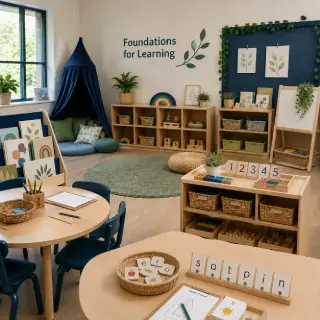
Reception classrooms look deliberately different from Year 1. Children learn through structured play, storytelling, and guided activity rather than desk-based instruction. Communication and language development sits at the heart of this – practitioners work to extend vocabulary, encourage listening, and build the kind of conversational confidence that underpins later reading and writing.
Building the Foundations for Classroom Learning
Early learning goals set expectations for what children should achieve by the end of Reception. These span literacy, mathematics, personal development, and self-regulation – the ability to manage emotions and follow instructions. Early number sense, phonological awareness, and the habit of sustained attention all develop here, preparing children for the more structured demands of Year 1.
How Learning Develops Across Key Stage 1 and Key Stage 2
Reception may be where school begins, but the years that follow mark a steady and deliberate shift from play-centred discovery towards structured academic learning. That shift doesn't happen overnight – it unfolds gradually across two key stages, each with distinct expectations for what children should know and be able to do.
Phonics and Early Reading in Key Stage 1
Systematic phonics sits at the heart of early literacy in England. From Year 1, children follow structured phonics programmes – such as Letters and Sounds or Read Write Inc – learning to decode words by matching sounds to letters. The Year 1 Phonics Screening Check, taken at age six, measures whether pupils have secured these foundations. Reading fluency built during Key Stage 1 underpins almost everything that follows.
Building Core Foundations Through the Primary Years
Writing, mathematics and science develop alongside reading, with expectations rising year by year. By Year 4, pupils sit a statutory multiplication tables check. Written work grows longer and more precise, and science moves from simple observation towards structured enquiry.
Greater Independence in the Junior Years
Upper Key Stage 2 asks noticeably more of children. Reasoning tasks, extended writing, and regular homework become part of the rhythm of school life. There's no denying that the jump from Year 3 to Year 6 can feel significant – pupils are expected to manage their own learning with far less hand-holding than in the infant years.
Why Assessment and Transition Matter Throughout the Primary Years
Statutory assessments in English primary schools are not about ranking children. They exist to track progress, flag where additional support is needed, and confirm readiness for the next stage of education.
Phonics, Tables, and End-of-Primary Tests
Year 1 pupils sit the phonics screening check, a short assessment of 40 words designed to confirm whether a child has secured the decoding skills taught through systematic phonics. Those who do not meet the expected standard retake it in Year 2. By Year 4, the multiplication tables check tests fluency across all tables up to 12×12, giving schools early sight of any gaps in mathematical recall. Key Stage 2 tests in Year 6 cover reading, grammar, punctuation, spelling, and mathematics, with results reported to parents and used to set secondary school baseline expectations.
Preparing Year 6 Pupils for Secondary School
Beyond test preparation, Year 6 carries a broader pastoral purpose. Teachers increasingly encourage pupils to manage their own timetables, take responsibility for homework, and navigate social challenges with less adult intervention. Many schools run dedicated transition programmes, including visits to local secondary schools and structured discussions about what to expect. The goal is not simply academic consolidation but building the confidence and independence that secondary school will demand from day one.
Primary School Lays the Foundations for Future Learning
Taken together, the journey from Reception through to Year 6 represents far more than a sequence of academic milestones. Children arrive in primary school learning to hold a pencil and leave it reading independently, writing extended prose, and reasoning through multi-step mathematics problems. Strong early grounding in phonics and numeracy, combined with the gradual shift towards independent working that defines the junior years, equips pupils to manage the greater demands of secondary school. Statutory assessments along the way – from the Phonics Screening Check to KS2 SATs – help schools identify where children need support before gaps become entrenched. There's no denying that how well a child navigates Year 7 often reflects the quality of what happened in those first seven years of formal English education.